I would like to focus my first blog on African American literature. It is something that has had an impact me since I was young. My mother brought a book home from an antique store. She told me to, "Check it out." When I did, I discovered that it was very old, I am not sure of the exact year, but I know that it was a few years after the end of the Civil War. It claimed to be the first book of collected freed slave literature. It contained poems, letters, short stories, and personal accounts of daily life as a slave or the newly freed slave. It had a profound effect on me. The authors had very little ability in writing. They wrote how they spoke. I knew this was from a lack of education that was imposed on them even to the point that it was illegal for them to be taught to read. However they gave very detailed and vivid description and expression of their experiences. They described the terror and sadness of life as a slave, and expressed the jubilation of newly found freedom. That experience fueled my interest in the literature of African Americans throughout that time. I wish I cite the book for you, but it has been lost for a long time.
What piece of African American literature has inspired you?
The Souls of Black Folk by W.E.B Du Bois
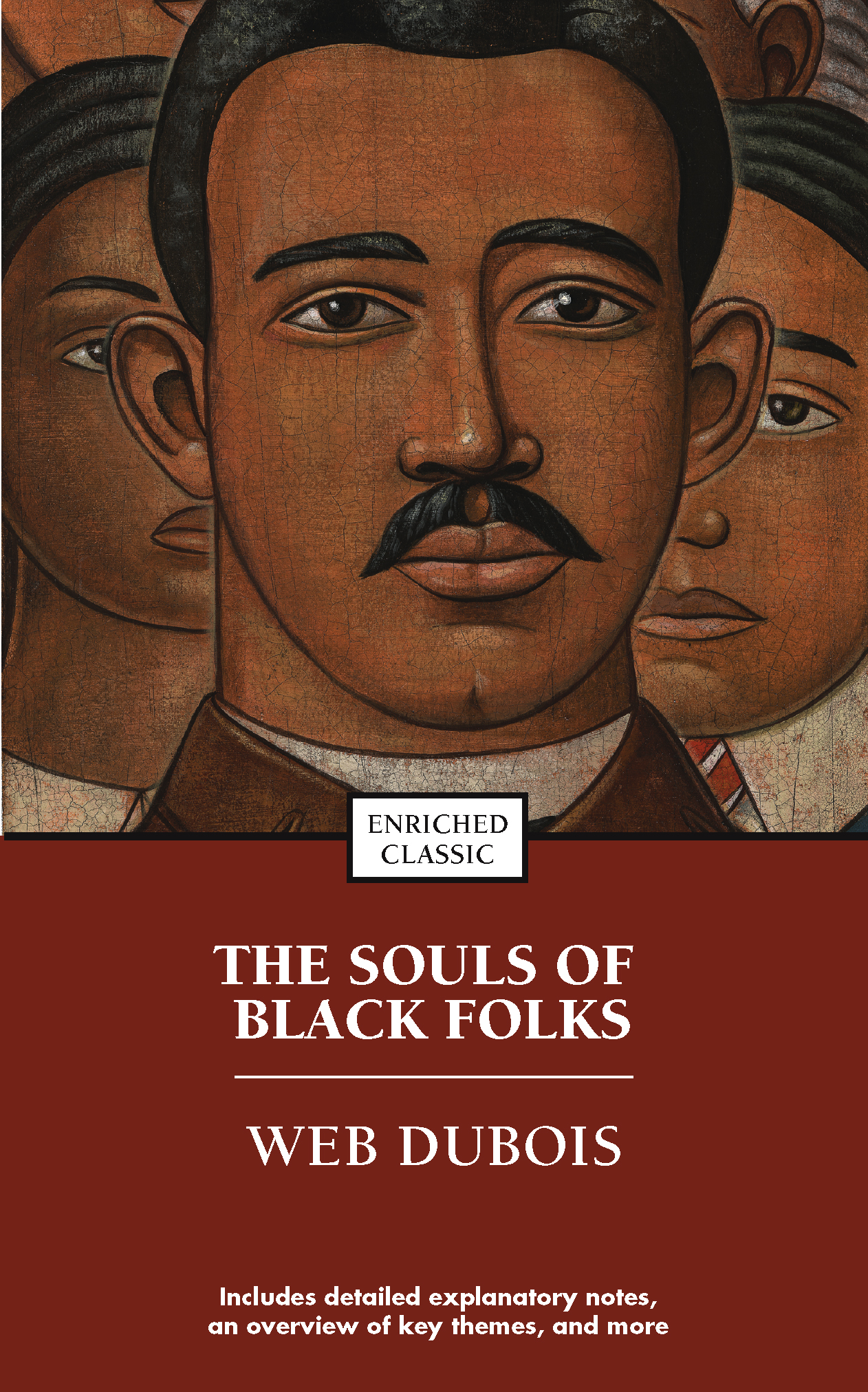
W.E.B. Du Bois lived from 1868 to 1963. He grew up in the Northeast, and received a Ph.D. in history in 1895.
The Souls of Black Folk, written in 1903 was a rhetorical essay aimed to bring light to the state of inequality that plagued the African American at that time. The arguments that he made resonate with me. I have tried to articulate the same ideas to folks that do not believe that racism exists. The arguments that he rebutted are still ideas that people still hold. It is hard to imagine that after all of the progress that we have made many are still in the dark ages of the Civil War period. If you are thinking, "Yawn, an essay?" then you are mistaken. W.E.B. Du Bois wrote eloquently, compellingly, and fervently on the subject. He also included excerpts from songs that were passed down from generation to generation of African Americans. Here are couple of excerpts from the book. Italics indicate a musical excerpt. Du Bois even included musical notation for the songs.
I. Of Our Spiritual Strivings
O water, voice of my heart, crying in the sand,
All night long crying with a mournful cry,
As I lie and listen, and cannot understand
the Voice of my heart in my side or the voice of the sea,
O water, crying for rest, is it I, it I?
Unresting water, there shall never be rest
Till the last moon droop and the last tide fail,
and the fire of the end begin to burn in the west;
and the heart shall be weary and wonder and cry like the sea,
All life long crying without avail,
As the water all night long is crying to e.
Arthur Symons
Between me and the other world there is ever an unasked question: unasked by some through feelings of delicacy; by others through the difficulty of rightly framing it. All, nevertheless, flutter round it. They approach me in a half-hesitant sort of way, eye me curiously or compassionately, and then, instead of saying directly, How does it feel to be a problem? they say, I know an excellent colored man in my town; or, I fought at Mechanicsville, or, Do not these Southern outrages make your blood boil? At these I smile, or am interested, or reduce the boiling to a simmer, as the occasion may require. To the real question, How does it feel to be a problem? I answer seldom a word (1717)
One never feels his two-ness, - an American, a Negro; two souls, two thoughts, two unreconciled strivings; two warring ideals in one dark body, whose dogged strength alone keeps it from being torn asunder (1718).
Du Bois, W.E.B, The Norton Anthology of American
Literature. Ed. Nina Baym. New York and London: W.W.
Norton and Company. 2013. 1717-1731. Print.